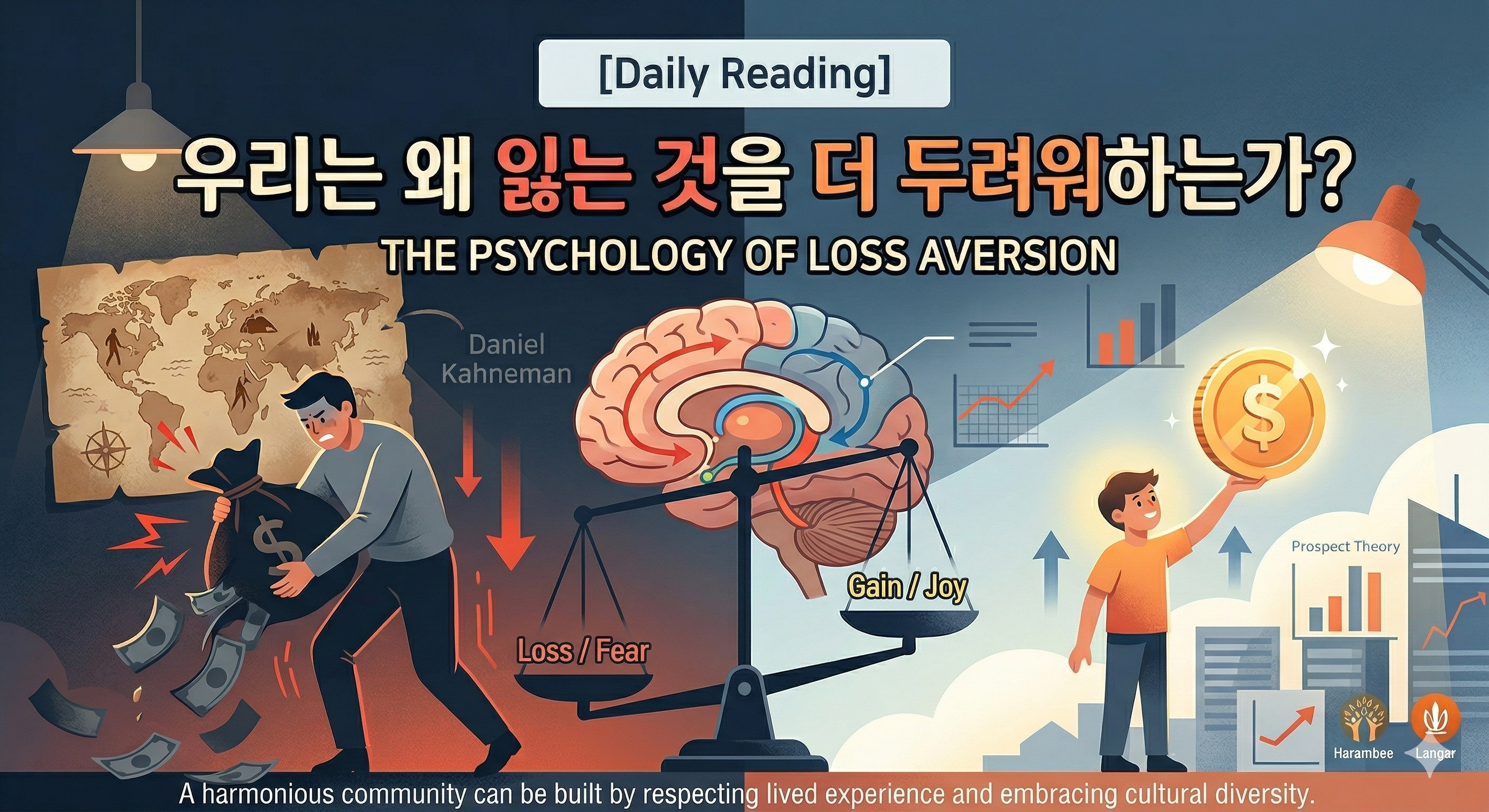
안녕하세요! 매일 저녁, 깊이 있는 통찰과 함께 영어 문해력을 키우는 [Daily Reading] 시간입니다.
오늘 여러분과 함께 읽어볼 글은 인간의 행동 심리학, 그중에서도 우리의 일상적인 선택을 지배하는 '손실 회피 편향(Loss Aversion Bias)'에 관한 에세이입니다. 우리는 왜 똑같은 가치라도 얻는 기쁨보다 잃는 고통을 훨씬 더 크게 느낄까요?
1. 오늘의 영문 에세이 원문 (Full Text)
[Title: The Psychology of Loss Aversion: Why We Fear Losing More Than We Love Winning]
Human beings like to think of themselves as rational actors, making decisions based on logic and objective calculation. However, behavioral psychology tells a remarkably different story. Driven by an evolutionary imperative to survive, the human brain is hardwired to experience the sting of losing a hundred dollars far more acutely than the joy of finding the exact same amount. This phenomenon, known as loss aversion, is a cornerstone of Prospect Theory, developed by Nobel laureates Daniel Kahneman and Amos Tversky.
In the ancient past, avoiding a loss—such as losing a day's food supply—was literally a matter of life and death, whereas gaining an extra day's supply was merely a bonus. Today, while we are no longer foraging in the wild, this primitive instinct still governs our daily lives. This cognitive bias explains why individuals tend to hold onto losing investments for too long, irrationally hoping for a rebound, rather than cutting their losses and moving on.
Recognizing loss aversion is the first step toward financial and emotional clarity. By understanding that our minds amplify the pain of a loss, we can step back, evaluate our choices objectively, and make decisions that are not dictated by ancient fears, but by future potential.
2. 필수 어휘장 (Vocabulary List)
원문을 수월하게 읽어내기 위해 꼭 알아야 할 핵심 영단어 10개입니다. 소리 내어 읽으며 문맥 속 의미를 기억해 보세요!
- Rational (형) 합리적인, 이성적인
- Evolutionary (형) 진화의, 진화론적인
- Imperative (명) 지상 과제, 필수 불가결한 것 / (형) 반드시 해야 하는
- Hardwired (형) 타고난, (생물학적으로) 내재된
- Acutely (부) 예민하게, 강렬하게, 뼈저리게
- Cornerstone (명) 초석, 주춧돌 (핵심이 되는 것)
- Forage (동) (식량 등을) 찾아다니다
- Primitive instinct (명) 원초적 본능
- Cognitive bias (명) 인지 편향
- Rebound (명) 반등, 회복 / (동) 다시 튀어 오르다
3. 오늘의 Article 요약 (Summary)
본 에세이는 인간이 합리적인 이성꾼(Rational Actor)이 아니라, 진화 과정에서 생존을 위해 '손실'에 극도로 민감하게 반응하도록 설계된 감정적 존재임을 설명합니다.
행동 심리학의 관점에서 보면, 길에서 10만 원을 주웠을 때의 기쁨보다, 주머니에서 10만 원을 잃어버렸을 때의 심리적 고통이 약 2배 더 강하다고 합니다. 이러한 심리적 기저는 우리가 일상에서 더 나은 기회를 잡기보다는, 단순히 현재 가진 것을 지키기 위해 비합리적인 결정을 내리게 만듭니다.
4. 문해력을 높이는 [구문 독해 포인트]
오늘 글의 핵심을 찌르는 명문장을 통해, 고급 구문을 익혀보겠습니다.
"Driven by an evolutionary imperative to survive, the human brain is hardwired to experience the sting of losing a hundred dollars far more acutely than the joy of finding the exact same amount."
🔍 구문 분석 가이드:
- Driven by ~: "~에 이끌려, ~에 의해 추진되어" (수동형 분사구문, 주어인 the human brain을 부연 설명)
- Imperative to survive: "생존하려는 지상 과제(필수 불가결한 것)"
- Is hardwired to ~: "~하도록 타고나다, ~하도록 (뇌의 회로가) 설계되어 있다"
- Far more acutely than ~: "~보다 훨씬 더 뼈저리게(민감하게)" (비교급 강조 부사 far)
📍 직독직해 연습:
생존하려는 진화적 지상 과제에 이끌려 / 인간의 뇌는 타고났다 / 100달러를 잃어버리는 고통을 경험하도록 / 정확히 같은 금액을 찾는 기쁨보다 훨씬 더 뼈저리게.
5. 문장 구조 정밀 분석 (Sentence Breakdown)
문장이 길어질 때 핵심 뼈대(주어와 동사)를 찾아내는 훈련입니다.
"This cognitive bias explains why individuals tend to hold onto losing investments for too long, irrationally hoping for a rebound, rather than cutting their losses and moving on."
- 주어(S): This cognitive bias (이러한 인지 편향은)
- 동사(V): explains (설명한다)
- 목적어(O): why individuals tend to hold onto losing investments for too long (왜 사람들이 손실이 나는 것에 너무 오래 매달리는 경향이 있는지를 / 의문사+주어+동사 간접의문문)
- 분사구문(동시동작): irrationally hoping for a rebound (비합리적으로 반등을 희망하면서)
- 비교 구문: rather than cutting their losses and moving on (손절하고 앞으로 나아가기보다는 / hoping과 병렬 구조)
6. 큐레이터 Reed의 한 줄 평
우리의 뇌가 애초에 '잃지 않기 위해' 설계되었다는 사실은 많은 것을 시사합니다. 무언가를 새로 시도하기가 두렵거나, 안 좋은 상황을 질질 끌고 있다면, 그것은 여러분이 부족해서가 아니라 단지 진화의 흔적인 '인지 편향'이 작동하고 있기 때문일지도 모릅니다.
오늘 하루, 여러분은 잃지 않기 위한 선택을 하셨나요, 아니면 얻기 위한 선택을 하셨나요? 댓글로 여러분의 경험을 들려주세요!
'밤의 Deep Reading' 카테고리의 다른 글
| [Daily Reading] 무기력한 EU? 국제 정세 속 '침묵'의 대가 (The Cost of Silence) (0) | 2026.04.02 |
|---|---|
| [Daily Reading] #03. 선택의 역설: 더 많은 선택지가 우리를 불행하게 만드는 이유 (1) | 2026.03.24 |
| [Daily Reading] #02. 타인의 잣대를 버려라: 현대 사회에서 '진정한 성공'을 재정의하다 (1) | 2026.03.20 |
| [Daily Reading] #01. 생산성의 함정: 왜 우리는 '느리게 생각하기'를 두려워하는가? (0) | 2026.03.19 |
| [Daily Reading] 데이터가 놓치는 1%: 알고리즘 시대에 '직관'이 필요한 이유 (1) | 2026.03.12 |


